Data, Analytics & AI
Ryan Miller’s executive project experience
AI Model Selection & Release Governance
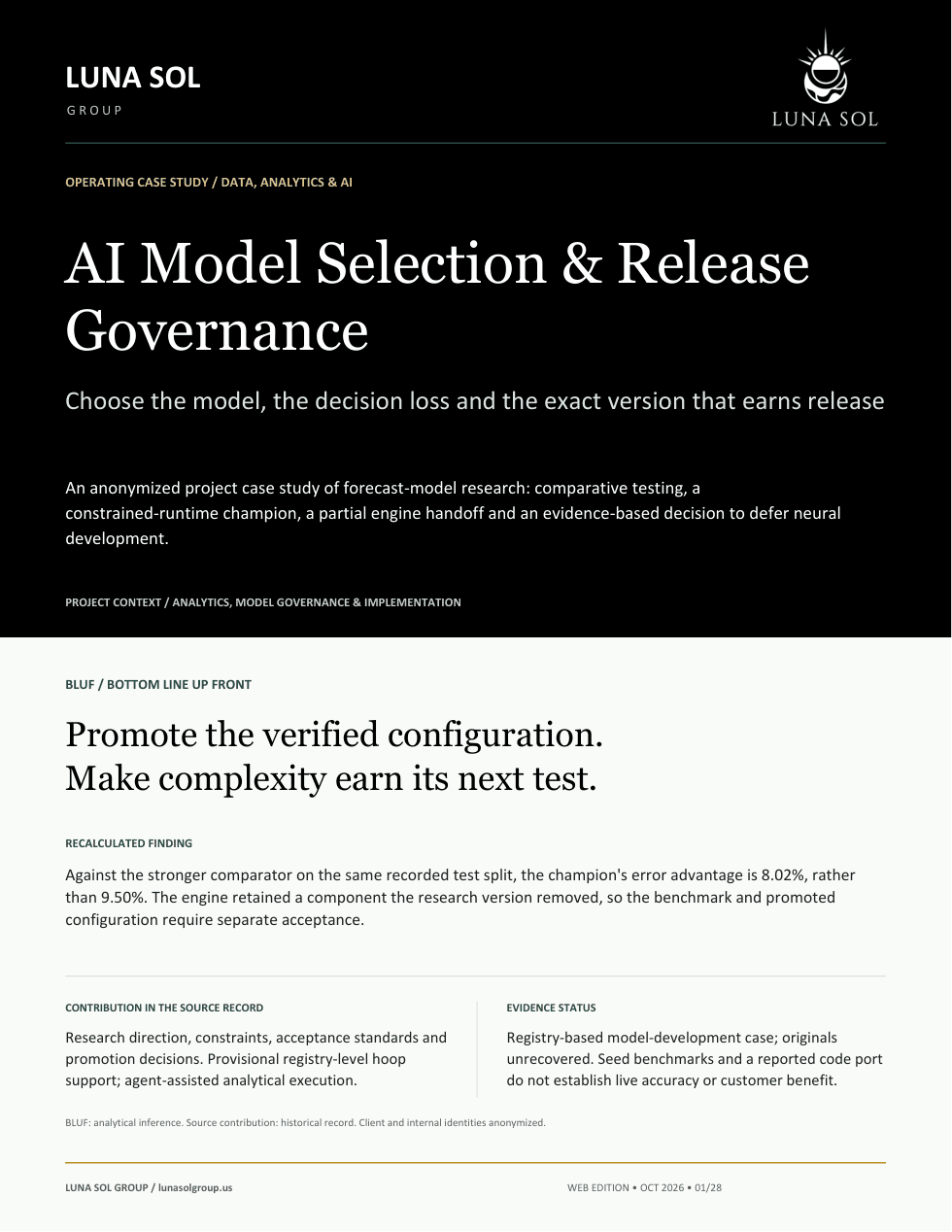
An anonymized project case study of forecast-model research: comparative testing, a constrained-runtime champion, a partial engine handoff and an evidence-based decision to defer neural development.
Executive brief
Promote the verified configuration. Make complexity earn its next test.
Role
Ryan Miller · Prior executive role
Mandate
Choose the model, the decision loss and the exact version that earns release
Operating lens
Data, Analytics & AI
Project overview
[AI] The registered research established a practical champion and a conditional neural-model deferral. Its durable contribution is a disciplined selection and promotion process, bounded by the evidence each stage actually supplies.
Context | Model Ambition Met A Constrained Operating Runtime
[HR] The project compared forecasting candidates against an incumbent, added uncertainty estimates, retained failed experiments and specified a neural-model go/no-go. The shipping environment favored a lightweight implementation; usable live history remained a dependency.
Objective | Choose The Next Model Investment And Release
[PD] Select on a common target, comparator and decision loss. Separate research selection, exact-configuration promotion and live acceptance so that one strong score cannot authorize all three.
Approach | Direct A Falsifiable Comparative Program
[HR] The project lead commissioned the review, imposed runtime and preservation constraints, set a falsification gate and directed goal-based severity decisions. [AI] These claims receive provisional registry-level hoop support. Analytical implementation was agent-assisted.
Findings | The Comparator And The Promoted Version Change The Claim
[RC] The champion’s recorded TEST error advantage is 8.02% against the stronger incumbent, versus 9.50% against the shipped baseline. [HR] The research configuration removed weather; the reported engine port retained it. Matching keys and aggregate error did not imply identical target realizations.
Decision Value | Fund An Authenticated Comparison, Then Authorize Scope
[PD] The analytics sponsor should freeze the loss and eligible comparator; the platform owner should verify configuration parity and rollback. Require an untouched final live evaluation with a positive lower 95% bound on prespecified incremental value, plus separately sized safety and capacity gates, before scaled promotion.
Implications | Keep Complexity Conditional Without Declaring It Futile
[AI] Two changed seed experiments do not establish a learning curve or neural inferiority. The proposed Champion Promotion Contract makes data access, selection validity, operating loss and runtime feasibility explicit conditions for the next investment.
Reading the evidence
The report distinguishes historical record [HR], recalculated findings [RC], analytical inference [AI] and proposed design [PD]. These labels describe the evidence supporting each statement about this actual project.
Contribution and evidence
What the record supports.
The analytical finding
Against the stronger comparator on the same recorded test split, the champion’s error advantage is 8.02%, rather than 9.50%. The engine retained a component the research version removed, so the benchmark and promoted configuration require separate acceptance.
Ryan’s documented contribution
Research direction, constraints, acceptance standards and promotion decisions. Provisional registry-level hoop support; agent-assisted analytical execution.
Attribution
Work performed by Ryan Miller in a prior executive role at a global commerce and logistics company. Registry-based model-development case; originals unrecovered. Seed benchmarks and a reported code port do not establish live accuracy or customer benefit.
Evidence
Explore the evidence behind the work.
AI Model Selection & Release Governance | 28-page public project report. Includes the executive storyline, technical methods, evidence boundaries and references.
Download the complete public case report (PDF)
The report protects internal identities and sensitive operating data. Private evidence annexes and source files are not published.