Luna Sol Group
Illustrative operating case | Synthetic model
Sequence integration around service continuity and cost.
A shared specialist team must stand up Finance, IT and HR before transition services expire. This operating case connects the work sequence to acceptance evidence, contractual rights and the cost of exit.

Model at a glance
$9,000 optimized difference
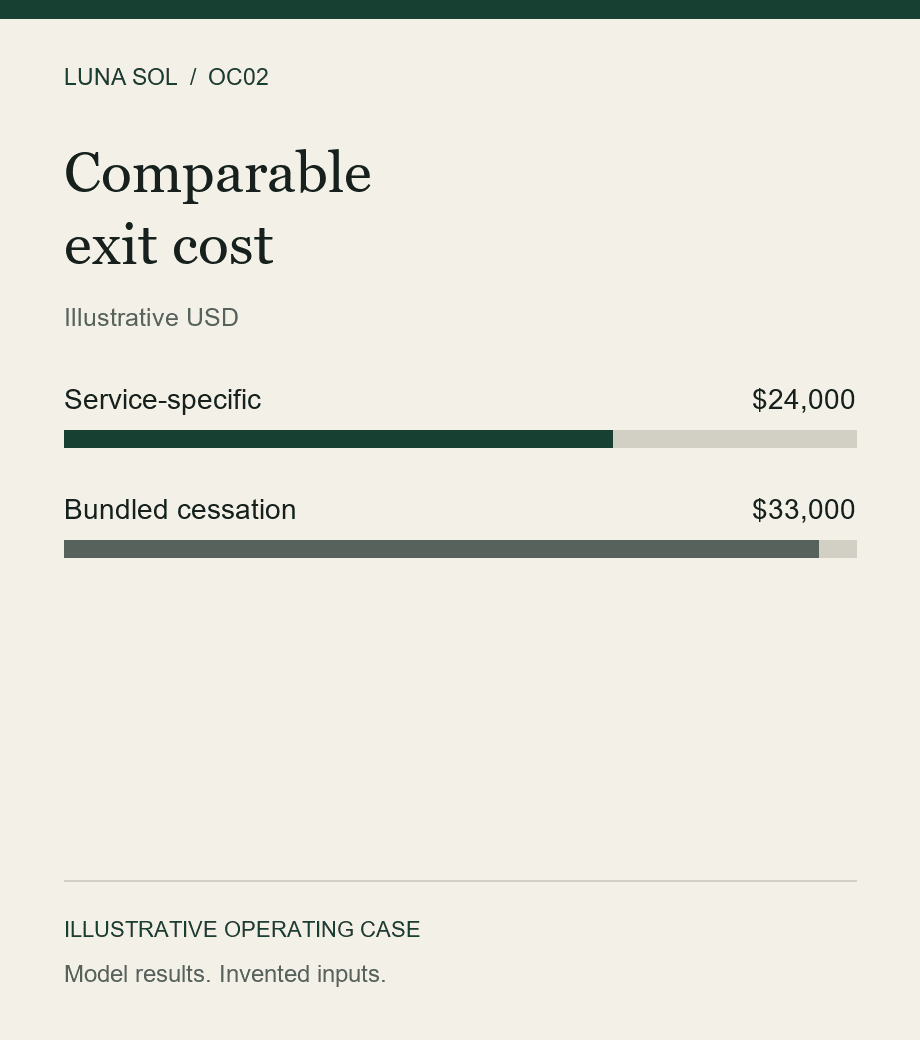
Service-specific exit costs $24,000 in the model; the best bundled-exit plan costs $33,000. Each contract structure is compared with its own reoptimized schedule.
Illustrative USD, durations and contractual rights. No completed acquisition, actual legal entitlement or realized savings is asserted.
Executive brief
Price the complete service exit before accelerating local tasks.
Role
Proposed integration lead
Mandate
Service transition and TSA exit
Operating lens
Continuity, dependencies and cost
Operating case
The challenge
An acquisition transition requires replacement Finance, IT and HR services while one specialist team supports migration and testing. The illustrative model begins with six weeks remaining on transition services and a maximum two-week extension already approved. Business continuity and acceptance remain constraints, even when the exit date is under pressure.
The visible milestone is migration completion. The economically relevant decision is when an accepted replacement service can actually cease its seller support and associated charge. Those dates depend on the contract as well as the project plan.
The approach
Luna Sol’s proposed approach joins five records: service obligation, resource-feasible work plan, business acceptance, authorized contingency and exit decision. It distinguishes technical cutover, operational acceptance, notice, cessation and final billing. Functional owners approve their services; the integration lead coordinates the dependencies and escalation.
The worked model enumerates six migration and test tasks, optional accelerations and two exit structures. Every comparison charges extension and acceleration on the same horizon. Testing is a required gate; assumed successful tests make a model schedule feasible but do not establish operational readiness.
The decision
With service-specific cessation and no acceleration, IT is accepted in week three, Finance in week six and HR in week eight. Only HR requires extension, costing $24,000. Reversing the Finance and HR sequence reduces the sum of acceptance dates but raises extension cost to $60,000. Both schedules finish in week eight.
A dedicated preparation acceleration advances one readiness date without advancing any service exit. Buying it adds $8,000 without changing the feasible schedule. By contrast, when all services must cease together, two migration accelerations create the best plan at $33,000. The fair difference between optimized exit structures is therefore $9,000. Holding an inferior bundled schedule fixed would inflate the apparent advantage.
How the work would reach the business
The proposed engagement starts with a service-to-entity map and a constrained dependency plan. Each cutover has a named acceptance owner, reconciled original transactions, support coverage and a documented recovery option. Finance tests financial controls; HR tests workforce services; IT tests the replacement environment and continuity dependencies.
The sponsor receives a next executable sequence and a priced fallback. No extension permits a $33,000 modeled fallback; one permitted week allows $27,000; two allow $24,000. Those alternatives only become executable when the relevant rights, qualified capacity and service evidence exist.
Designed operating system
A service-to-exit operating protocol
Establish the obligation
Map services, entities, cessation rules, notice and the authorized decision makers.
Prove the replacement
Reconcile transactions, test the controls and secure business acceptance and support.
Close the service
Confirm authorized notice, contingency, records retention and the final charge boundary.
Decision value
A schedule can look faster and cost more
The analysis shows why local completion targets can misallocate a shared team. Sequence should reflect business deadlines, contract rights and avoidable extension cost, with all critical controls preserved.
A live engagement would replace the assumed acceptance and contractual conditions with verified evidence, then track continuity, mature transaction performance and actual cessation. The modeled cost comparison does not establish a client saving.
Attribution
Luna Sol authored this illustrative operating design and reproducible analysis. The scenario, figures and modeled conditions are invented. Proposed responsibilities describe how an engagement would be approached; they do not claim a completed client engagement, implementation or realized benefit.
Evidence
Explore the evidence behind the work.
The 20-page public case contains the scenario assumptions, calculations, primary-method references, sensitivity analysis, evaluation design and limitations. The web story summarizes that document; it is not a new source of historical performance.